

How Much Should You Contribute to Your HSA?
A Health Savings Account (HSA) can be one of the most valuable tools available for managing healthcare expenses and building long-term financial security. Eligible individuals can contribute pre-tax dollars, use those funds tax-free for qualified medical expenses, and allow unused balances to roll over from year to year. Because of these advantages, many participants want to know how much they should contribute to their HSA each year.
The answer depends on several factors, including your expected healthcare expenses, your health plan design, any employer contributions you receive, and your overall financial goals. While there is no universal contribution amount that works for everyone, there are several guidelines that can help you determine a contribution strategy that aligns with your needs.
Confirm That You Are Eligible to Contribute
Before determining how much to contribute, it is important to confirm that you are eligible to make HSA contributions.
In general, individuals must be enrolled in an HSA-qualified High-Deductible Health Plan (HDHP) to contribute to an HSA. Certain types of additional coverage may affect eligibility, including enrollment in a general-purpose Flexible Spending Account (FSA). Changes to your healthcare coverage throughout the year, such as enrolling in Medicare, changing health plans, or gaining access to other disqualifying coverage, can also impact your ability to contribute.
It is important to understand that HSA eligibility and HSA ownership are separate concepts. Funds already deposited into an HSA generally remain yours even if you change employers or health plans. However, your eligibility to make new contributions may change from year to year based on your healthcare coverage.
If you are uncertain about your eligibility, consult your employer, benefits administrator, or HSA provider before establishing contribution elections.
Understand Annual Limits
The Internal Revenue Service (IRS) establishes annual contribution limits for HSAs. These limits represent the maximum amount that can be deposited into an HSA during a calendar year.
The annual limit includes all contributions made to the account, including employee payroll deductions, direct contributions made by the account holder, and employer contributions. Employer funding counts toward the same annual limit and does not increase the maximum amount that can be contributed.
For 2026, the HSA contribution limits are:
- Self-only coverage: $4,400
- Family coverage: $8,750
- Catch-up contribution for individuals age 55 and older: $1,000
For 2027, the HSA contribution limits are:
- Self-only coverage: $4,500
- Family coverage: $9,000
- Catch-up contribution for individuals age 55 and older: $1,000
Individuals who are only eligible to contribute for part of the year may have a prorated contribution limit. Participants who maintain multiple HSAs should also remember that the annual limit applies across all HSA accounts combined.
Understanding these limits provides a foundation for determining an appropriate contribution strategy.
Start by Estimating Your Healthcare Expenses
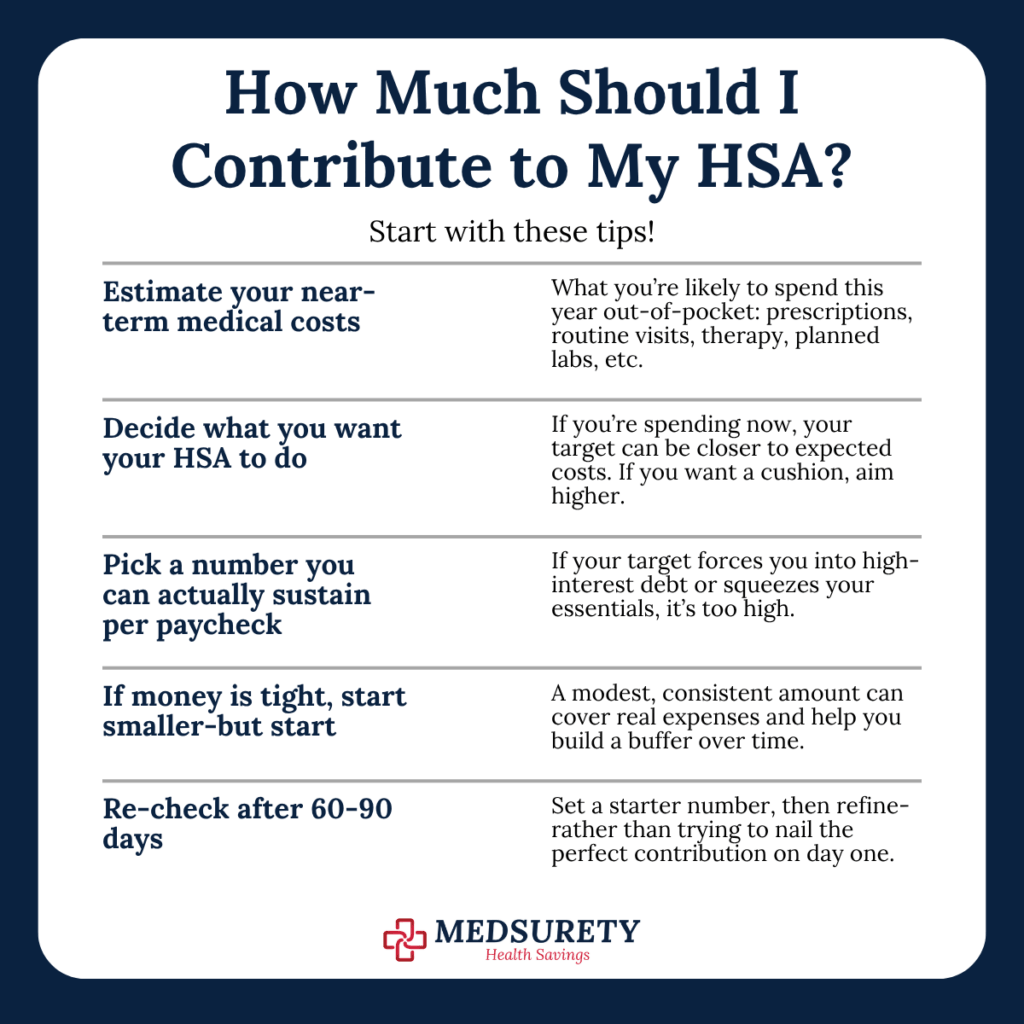
One of the most practical ways to determine an HSA contribution amount is to estimate your anticipated healthcare expenses for the year.
Review your healthcare spending from previous years and consider any expenses you expect to incur in the coming year. Common expenses may include prescription medications, primary care visits, specialist appointments, laboratory services, physical therapy, mental health services, dental care, vision care, and planned medical procedures.
When estimating expenses, focus on the amount you expect to pay out of pocket rather than the total cost of care. Your health plan may cover a portion of healthcare expenses, so your contribution goal should reflect the costs you anticipate paying personally.
You may also want to account for known life events or healthcare needs that could increase medical spending. Examples include pregnancy, orthodontic treatment, ongoing management of a chronic condition, or planned surgeries and diagnostic procedures.
Creating a realistic estimate of your expected healthcare expenses can provide a useful starting point when establishing your annual contribution goal.
Choose Your HSA Contribution Goal
Once you understand your contribution limits and have estimated your healthcare expenses, the next step is deciding how much you want to save in your HSA.
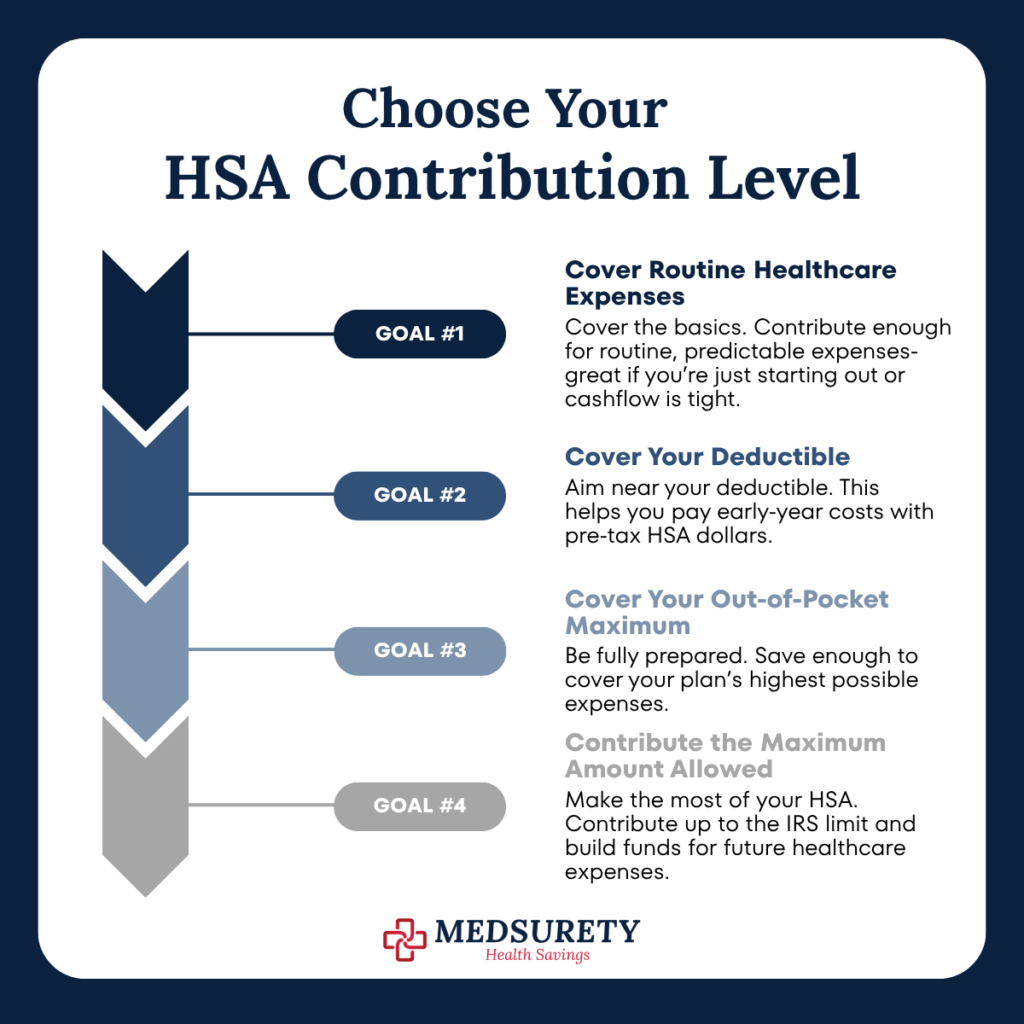
The right amount depends on your healthcare needs, financial goals, and monthly budget. Many people find it helpful to think about their contribution goal in one of four categories.
Goal #1: Cover Routine Healthcare Expenses
If you mainly use your HSA to pay for healthcare expenses throughout the year, you may want to contribute enough to cover your expected costs.
This could include expenses such as prescription medications, doctor visits, dental care, vision care, or other routine healthcare needs. This approach can be a practical starting point for individuals who are new to HSAs or prefer to begin with a contribution amount that comfortably fits their budget.
Goal #2: Cover Your Deductible
Many HSA participants choose to save enough to cover their health plan deductible.
Your deductible is the amount you must pay out of pocket before your health plan begins sharing more of the cost of covered services. Having enough money in your HSA to cover the deductible can help you prepare for unexpected medical expenses and reduce financial stress if you need care.
Goal #3: Cover Your Out-of-Pocket Maximum
If you want additional financial protection, you may choose to save toward your plan’s out-of-pocket maximum.
The out-of-pocket maximum is generally the most you would have to pay for covered healthcare services during the plan year. Reaching this savings goal can help you prepare for years when healthcare expenses are higher than expected.
This approach may be helpful for individuals with ongoing medical conditions, planned procedures, or family members who regularly use healthcare services.
Goal #4: Contribute the Maximum Amount Allowed
Some individuals choose to contribute the maximum amount allowed by the IRS each year.
This strategy allows you to take full advantage of the tax benefits an HSA offers while building savings for future healthcare expenses. Because unused HSA funds roll over from year to year, money you do not spend today can be saved for future medical expenses, including those that may occur during retirement.
Which Goal is Right for You?
There is no one-size-fits-all answer.
The appropriate contribution goal will vary from person to person. Factors such as age, family size, healthcare utilization, and financial priorities can all influence the amount that makes sense for a particular individual.
The best contribution goal is one that fits your healthcare needs and your budget. A contribution amount you can comfortably maintain throughout the year is often more effective than setting a goal that is difficult to sustain.
Calculate your Per-Paycheck Contribution
After establishing an annual contribution goal, it can be helpful to convert that amount into a per-paycheck contribution.
Dividing your annual goal by the number of pay periods you receive each year can make the savings target feel more manageable and help ensure contributions occur consistently.
For example, a participant who wants to contribute $2,400 annually and receives 24 paychecks per year would contribute approximately $100 per paycheck. A participant targeting $3,900 annually would contribute approximately $162.50 per paycheck under the same payroll schedule.
|
PAY FREQUENCY |
ANNUAL TARGET (EXAMPLE) |
PER-PAYCHECK CONTRIBUTION (FORMULA) |
|
Weekly |
$2,400 |
$2,400 ÷ 52 = $46.15 |
|
Biweekly |
$2,400 |
$2,400 ÷ 26 = $92.31 |
|
Semimonthly |
$2,400 |
$2,400 ÷ 24 = $100 |
|
Monthly |
$2,400 |
$2,400 ÷ 12 = 200 |
Payroll deductions often provide a convenient way to automate HSA contributions while taking advantage of available tax savings.
When calculating payroll contributions, remember to account for any employer contributions that may be deposited into your HSA during the year.
Should You Maximize Your HSA Contributions?
For some individuals, contributing the maximum amount allowed by the IRS may be an effective long-term strategy.
Maximizing HSA contributions may make sense for participants who have stable cash flow, adequate emergency savings, and the ability to comfortably fund healthcare expenses and other financial obligations. It may also appeal to individuals who want to build healthcare savings for retirement or take full advantage of the tax benefits associated with an HSA.
However, maximizing HSA contributions is not necessary for everyone. Participants should ensure that HSA contributions fit comfortably within their overall financial plan and do not interfere with essential expenses or other important savings goals.
A contribution strategy should support financial stability while helping participants prepare for current and future healthcare expenses.
|
If This Sounds Like You… |
Contribution Goal |
Suggested Approach |
|
You rarely visit the doctor and have a few healthcare expenses. |
Cover basic healthcare costs. |
Contribute enough to cover routine expenses such as prescriptions, annual checkups, and occasional office visits. |
|
You expect to use healthcare services throughout the year. |
Cover expected medical expenses. |
Estimate your annual out-of-pocket healthcare costs and consider adding a small cushion for unexpected expenses. |
|
You want protection from larger medical bills. |
Cover your deductible. |
Consider building your HSA balance until it equals your health plan deductible. |
|
You have ongoing healthcare needs or want greater financial protection. |
Cover your out-of-pocket maximum. |
Consider saving enough to cover your plan’s annual out-of-pocket maximum. |
|
You want to maximize tax savings and build long-term healthcare savings. |
Contribute the IRS maximum. |
Contribute up to the annual IRS limit if it fits comfortably within your budget and financial goals. |
|
Your coverage changes during the year. |
Adjust your contributions. |
Review your contribution elections and recalculate your annual limit based on the months you were eligible to contribute to an HSA. |
Review Your Contributions Throughout the Year
Healthcare needs and financial circumstances can change throughout the year.
New medications, planned procedures, changes in family coverage, the birth of a child, or changes in income may all affect the amount you want to contribute to your HSA.
Reviewing your contribution elections periodically can help ensure that your savings strategy remains aligned with your goals. Many participants find it helpful to evaluate their contributions at least once or twice during the year and make adjustments if necessary.
Regular reviews can help prevent both underfunding and overfunding while ensuring contributions remain appropriate for your situation.
Common Contribution Mistakes to Avoid
While HSAs offer significant flexibility, there are several common mistakes participants should avoid.
One of the most common errors is exceeding the annual contribution limit. Because employer contributions count toward the same annual maximum, it is important to monitor total contributions throughout the year.
Participants should also pay attention to changes in eligibility. Mid-year changes to healthcare coverage can affect contribution limits and may require adjustments to payroll elections.
Another common mistake is failing to revisit contribution amounts after major life events or healthcare changes. Contribution elections established at the beginning of the year may no longer reflect actual healthcare needs several months later.
Maintaining accurate records and reviewing contributions periodically can help avoid unnecessary tax complications and ensure your HSA continues to support your financial goals.
The Bottom Line
The right HSA contribution amount depends on your healthcare expenses, health plan design, financial priorities, and long-term goals.
For some individuals, contributing enough to cover anticipated healthcare expenses may be appropriate. Others may choose to save toward their deductible or out-of-pocket maximum, while some may seek to maximize annual contributions and build healthcare savings for the future.
By understanding your eligibility, estimating healthcare expenses, evaluating your financial goals, and reviewing contributions regularly, you can develop an HSA contribution strategy that supports both your current healthcare needs and your long-term financial well-being.